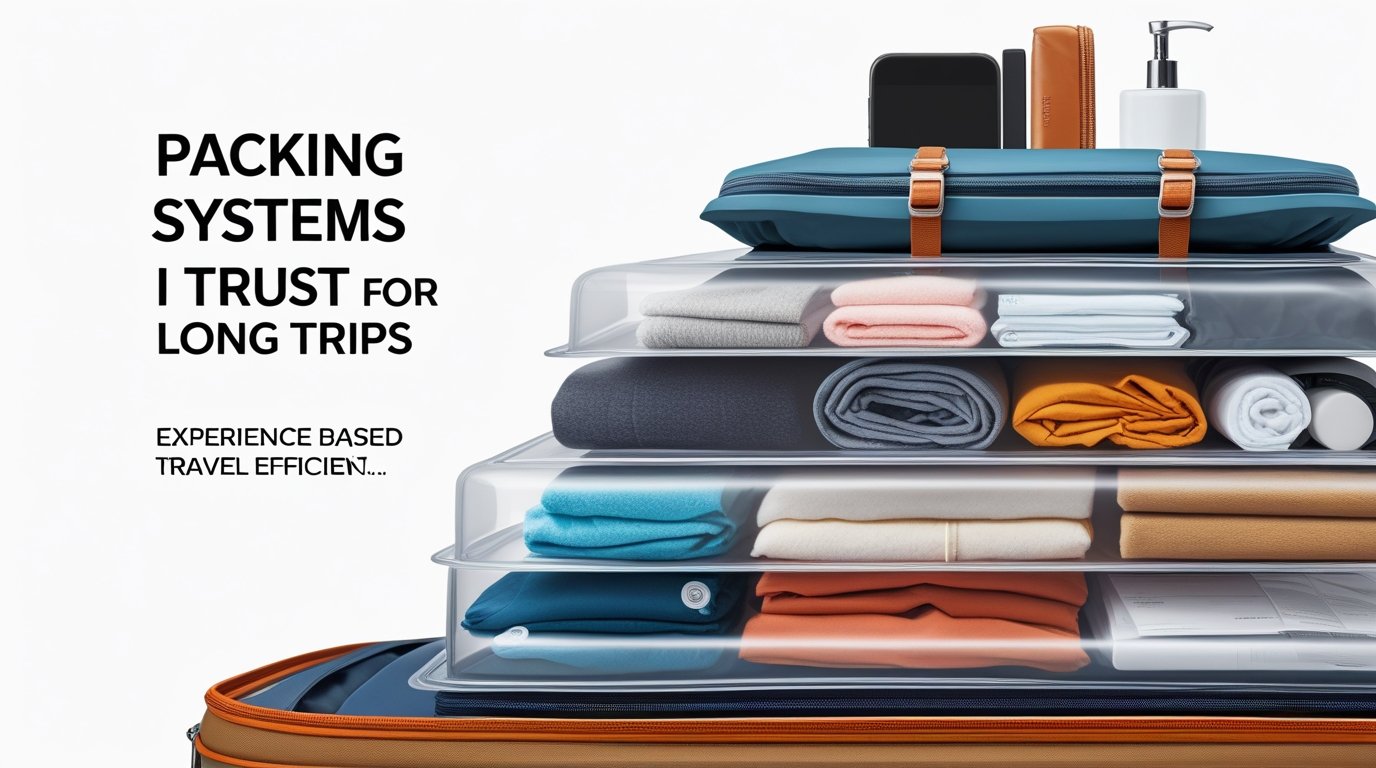
I used to be a “just-in-case” packer. I would stare at my open suitcase two nights before a flight, paralyzed by the fear that I might need a heavy coat in the tropics or three pairs of formal shoes for a hiking trip. I’d end up sitting on my suitcase to zip it shut, only to spend my entire vacation rummaging through a mountain of wrinkled clothes to find one clean pair of socks.
After a grueling three-month stint across Southeast Asia and Europe with a bag that weighed nearly 50 pounds, I broke. I realized that over-packing isn’t just about weight; it’s a mental burden. It makes transitions stressful and ruins the spontaneity of travel. Since then, I’ve spent years perfecting the Packing Systems that allow me to live out of a single carry-on for months at a time. This isn’t just about folding clothes; it’s about a modular architecture for your life on the road.
The Philosophy of the “Modular” Bag:
The biggest mistake travelers make is treating their suitcase like a single large box. When you do that, gravity becomes your enemy. Everything settles at the bottom, and the item you need is always at the base of the pile.
1. The “Drawers” Concept:
I now treat my backpack or suitcase like a chest of drawers. Every category of item has its own dedicated “container.” This means if I need a charging cable, I don’t look “in my bag”; I look in my Tech Pouch. If I need a clean shirt, I go to my Medium Compression Cube.
2. The Weight Distribution Rule:
I learned this from backcountry hikers. Your heavy items (shoes, toiletry kits) should be in the middle of the bag, as close to your back as possible. This keeps the center of gravity stable. Your light items (socks, rain shell) go at the top and bottom.
The Core Component: Compression Packing Cubes:
If you aren’t using packing cubes, you are essentially playing Tetris with soft, oddly shaped pillows. It’s an impossible game.
1. Why Compression Matters:
Standard cubes keep things organized, but Compression Cubes have an extra zipper that squishes the air out. I can fit roughly 30% more clothing into the same space using these.
- My Personal Set: I use a three-cube system.
- Large: All “bottoms” (pants, shorts) and outerwear.
- Medium: All “tops” (T-shirts, button-downs).
- Small: Underwear and socks.
2. The “Roll and Fold” Technique:
I don’t just throw clothes in the cubes. I use the “Ranger Roll” for T-shirts and a flat-fold for trousers. Rolling prevents deep creases and allows you to see every item at a glance when you open the cube.
The Tech Management System:
In 2025, we are all digital nomads to some extent. Between the laptop, phone, camera, e-reader, and power bank, the “spaghetti” of cables can become a nightmare.
1. The “One Cable” Goal:
I’ve spent the last year transitioning every device I own to USB-C. My laptop, phone, and even my toothbrush now use the same port. This allowed me to ditch a bag full of proprietary bricks for a single 65W GaN (Gallium Nitride) charger.
2. The Padded Tech Pouch:
I use a dedicated pouch with elastic loops.
- The “Daily Carry” Loop: One short cable for my power bank.
- The “Work” Loop: My laptop charger and a multi-port adapter.
- The “Backup”: A spare set of wired earbuds (because Bluetooth always fails when you need it most).
The 5-4-3-2-1 Rule for Clothing:
For a long trip, you don’t pack for the duration; you pack for a one-week cycle. If you can survive for seven days, you can survive for seven months.
- 5 Sets of Underwear and Socks: These are the items that get dirty fastest.
- 4 Tops: A mix of base layers and one “nice” shirt.
- 3 Bottoms: One pair of jeans (worn on the plane), one pair of lightweight chinos, and one pair of athletic shorts (which double as swimwear).
- 2 Pairs of Shoes: One pair of comfortable walking/hiking shoes (on your feet) and one pair of versatile, flat-packing sandals or Chelsea boots.
- 1 Outer Layer: A high-quality rain shell or a packable down jacket.
The “Dry” vs. “Wet” Toiletry System:
Leaky shampoo bottles are the leading cause of “bag-death.” I’ve moved away from liquids entirely where possible.
1. The Solid Revolution:
I now use solid shampoo bars, solid conditioner, and solid cologne.
- Benefits: They don’t count toward your “3-1-1” liquid limits at security, they take up half the space, and they can’t leak.
2. The TSA-Ready Pouch:
For the liquids I still have (sunscreen, toothpaste), I use a transparent, heavy-duty TPU pouch. It’s more durable than a Ziploc and stays permanently packed. I never “unpack” my toiletries at home; they live in their bag, ready to go.
The “In-Flight” Essentials Stack:
There is nothing worse than being in a middle seat and realizing your headphones are in the overhead bin.
- The Seatback Pouch: I have a tiny, flat pouch that contains:
- Earplugs and an eye mask.
- My Kindle.
- A small tin of mints.
- Lip balm.
- The Move: As soon as I board, I pull this pouch out and put it in the seat pocket. Everything else stays in the bin. My “personal space” stays clutter-free.
Dealing with Laundry on the Road:
If you are traveling long-term, you will be doing laundry. My system includes a “Laundry Infrastructure” within the bag.
- The Scrubba Bag: It’s a dry bag with an internal washboard. I can wash three days of clothes in a hotel sink in about five minutes.
- The Travel Clothesline: A braided, peg-less line that attaches to any bathroom fixture.
- The Odor-Control Cube: I use one specialized cube with an antimicrobial coating for dirty laundry to keep the “stink” from migrating to my clean clothes.
Security and Documentation:
I don’t keep all my eggs in one basket.
- The “Dummy” Wallet: I carry a cheap wallet with a few expired cards and a small amount of cash in my pocket. My real wallet stays in a hidden, RFID-blocking pocket in my bag.
- The Digital Vault: I keep encrypted scans of my passport, visas, and vaccination records on a secure cloud drive and a physical USB stick hidden in the lining of my bag.
Conclusion:
A perfect packing system is a work in progress. Every trip I take, I realize I brought one thing I didn’t need and missed one thing I did. But by moving to a modular, compression-based system, I’ve reclaimed my freedom. I can walk five miles through a new city to my hostel because my bag isn’t a burden. I can find my passport in three seconds. When you master your gear, you stop being a “tourist” struggling with luggage and start being a “traveler” engaging with the world.
FAQs:
1. What is the best brand of packing cubes?
I’ve found that Peak Design or Eagle Creek offer the most durable compression zippers for long-term use.
2. Hard-shell or Soft-shell luggage?
Soft-shell is better for long trips because it has “give” and fits into awkward bus or train compartments more easily.
3. How do I stop my clothes from smelling after a month?
Pack a few dryer sheets between your cubes or use a small cedar wood block to absorb moisture and odor.
4. Should I buy a travel-specific towel?
Yes, a microfiber or linen towel dries ten times faster than cotton and takes up a fraction of the space.
5. How do I pack a suit or a dress without wrinkles?
Place it inside a dry-cleaner plastic bag before folding it into your compression cube; the plastic prevents the fabric from “locking” into creases.
6. What is the one item you never travel without? A universal power adapter with at least four built-in USB